The Waste Land
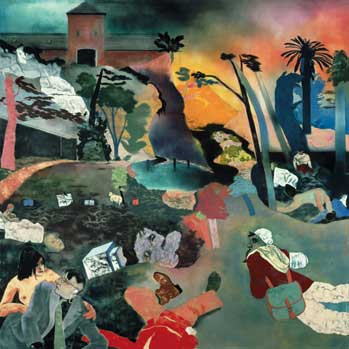
"If Not, Not" - R. B. Kitaj
T. S. Elliot (1888-1965)
�

|
I. THE BURIAL OF THE DEAD
|
|
|
Lilacs out of the dead land, mixing |
|
|
Memory and desire, stirring |
|
|
Dull roots with spring rain. |
|
|
Winter kept us warm, covering |
|
|
Earth in forgetful snow, feeding |
|
|
A little life with dried tubers. |
|
|
Summer surprised us, coming over the Starnbergersee |
|
|
With a shower of rain; we stopped in the colonnade, |
|
|
And went on in sunlight, into the Hofgarten, |
|
|
And drank coffee, and talked for an hour. |
|
|
Bin gar keine Russin, stamm' aus Litauen, echt deutsch. |
|
|
And when we were children, staying at the archduke's, |
|
|
My cousin's, he took me out on a sled, |
|
|
And I was frightened. He said, Marie, |
|
|
Marie, hold on tight. And down we went. |
|
|
In the mountains, there you feel free. |
|
|
I read, much of the night, and go south in the winter. |
|
|
|
|
|
What are the roots that clutch, what branches grow |
|
|
Out of this stony rubbish? Son of man, |
|
|
You cannot say, or guess, for you know only |
|
|
A heap of broken images, where the sun beats, |
|
|
And the dead tree gives no shelter, the cricket no relief, |
|
|
And the dry stone no sound of water. Only |
|
|
There is shadow under this red rock, |
|
|
(Come in under the shadow of this red rock), |
|
|
And I will show you something different from either |
|
|
Your shadow at morning striding behind you |
|
|
Or your shadow at evening rising to meet you; |
|
|
I will show you fear in a handful of dust. |
|
|
Frisch weht der Wind |
|
|
Der Heimat zu. |
|
|
Mein Irisch Kind, |
|
|
Wo weilest du? |
|
|
'You gave me hyacinths first a year ago; |
|
|
'They called me the hyacinth girl.' |
|
|
�Yet when we came back, late, from the Hyacinth garden, |
|
|
Your arms full, and your hair wet, I could not |
|
|
Speak, and my eyes failed, I was neither |
|
|
Living nor dead, and I knew nothing, |
|
|
Looking into the heart of light, the silence. |
|
|
Od' und leer das Meer. |
|
|
|
|
|
Madame Sosostris, famous clairvoyante, |
|
|
Had a bad cold, nevertheless |
|
|
Is known to be the wisest woman in Europe, |
|
|
With a wicked pack of cards. Here, said she, |
|
|
Is your card, the drowned Phoenician Sailor, |
|
|
(Those are pearls that were his eyes. Look!) |
|
|
Here is Belladonna, the Lady of the Rocks, |
|
|
The lady of situations. |
|
|
Here is the man with three staves, and here the Wheel, |
|
|
And here is the one-eyed merchant, and this card, |
|
|
Which is blank, is something he carries on his back, |
|
|
Which I am forbidden to see. I do not find |
|
|
The Hanged Man. Fear death by water. |
|
|
I see crowds of people, walking round in a ring. |
|
|
Thank you. If you see dear Mrs. Equitone, |
|
|
Tell her I bring the horoscope myself: |
|
|
One must be so careful these days. |
|
|
|
|
|
Unreal City, |
|
|
Under the brown fog of a winter dawn, |
|
|
A crowd flowed over London Bridge, so many, |
|
|
I had not thought death had undone so many. |
|
|
Sighs, short and infrequent, were exhaled, |
|
|
And each man fixed his eyes before his feet. |
|
|
Flowed up the hill and down King William Street, |
|
|
To where Saint Mary Woolnoth kept the hours |
|
|
With a dead sound on the final stroke of nine. |
|
|
There I saw one I knew, and stopped him, crying 'Stetson! |
|
|
'You who were with me in the ships at Mylae! |
|
|
'That corpse you planted last year in your garden, |
|
|
'Has it begun to sprout? Will it bloom this year? |
|
|
'Or has the sudden frost disturbed its bed? |
|
|
'Oh keep the Dog far hence, that's friend to men, |
|
|
'Or with his nails he'll dig it up again! |
|
|
'You! hypocrite lecteur!�mon semblable,�mon fr�re!' |
|
|
|
|
|
II. A GAME OF CHESS
|
|
|
Glowed on the marble, where the glass |
|
|
Held up by standards wrought with fruited vines |
|
|
From which a golden Cupidon peeped out |
|
|
(Another hid his eyes behind his wing) |
|
|
Doubled the flames of sevenbranched candelabra |
|
|
Reflecting light upon the table as |
|
|
The glitter of her jewels rose to meet it, |
|
|
From satin cases poured in rich profusion; |
|
|
In vials of ivory and coloured glass |
|
|
Unstoppered, lurked her strange synthetic perfumes, |
|
|
Unguent, powdered, or liquid�troubled, confused |
|
|
And drowned the sense in odours; stirred by the air |
|
|
That freshened from the window, these ascended |
|
|
In fattening the prolonged candle-flames, |
|
|
Flung their smoke into the laquearia, |
|
|
Stirring the pattern on the coffered ceiling. |
|
|
Huge sea-wood fed with copper |
|
|
Burned green and orange, framed by the coloured stone, |
|
|
In which sad light a carv�d dolphin swam. |
|
|
Above the antique mantel was displayed |
|
|
As though a window gave upon the sylvan scene |
|
|
The change of Philomel, by the barbarous king |
|
|
So rudely forced; yet there the nightingale |
|
|
Filled all the desert with inviolable voice |
|
|
And still she cried, and still the world pursues, |
|
|
'Jug Jug' to dirty ears. |
|
|
And other withered stumps of time |
|
|
Were told upon the walls; staring forms |
|
|
Leaned out, leaning, hushing the room enclosed. |
|
|
Footsteps shuffled on the stair. |
|
|
Under the firelight, under the brush, her hair |
|
|
Spread out in fiery points |
|
|
Glowed into words, then would be savagely still. |
|
|
|
|
|
'My nerves are bad to-night. Yes, bad. Stay with me. |
|
|
'Speak to me. Why do you never speak? Speak. |
|
|
'What are you thinking of? What thinking? What? |
|
|
'I never know what you are thinking. Think.' |
|
|
|
|
|
I think we are in rats' alley |
|
|
Where the dead men lost their bones. |
|
|
|
|
|
'What is that noise?' |
|
|
The wind under the door. |
|
|
'What is that noise now? What is the wind doing?' |
|
|
Nothing again nothing. |
|
|
'Do |
|
|
'You know nothing? Do you see nothing? Do you remember |
|
|
'Nothing?' |
|
|
I remember |
|
|
Those are pearls that were his eyes. |
|
|
'Are you alive, or not? Is there nothing in your head?' |
|
|
But |
|
|
O O O O that Shakespeherian Rag� |
|
|
It's so elegant |
|
|
So intelligent |
|
|
'What shall I do now? What shall I do?' |
|
|
'I shall rush out as I am, and walk the street |
|
|
'With my hair down, so. What shall we do to-morrow? |
|
|
'What shall we ever do?' |
|
|
The hot water at ten. |
|
|
And if it rains, a closed car at four. |
|
|
And we shall play a game of chess, |
|
|
Pressing lidless eyes and waiting for a knock upon the door. |
|
|
|
|
|
When Lil's husband got demobbed, I said� |
|
|
I didn't mince my words, I said to her myself, |
|
|
HURRY UP PLEASE IT'S TIME |
|
|
Now Albert's coming back, make yourself a bit smart. |
|
|
He'll want to know what you done with that money he gave you |
|
|
To get yourself some teeth. He did, I was there. |
|
|
You have them all out, Lil, and get a nice set, |
|
|
He said, I swear, I can't bear to look at you. |
|
|
And no more can't I, I said, and think of poor Albert, |
|
|
He's been in the army four years, he wants a good time, |
|
|
And if you don't give it him, there's others will, I said. |
|
|
Oh is there, she said. Something o' that, I said. |
|
|
Then I'll know who to thank, she said, and give me a straight look. |
|
|
HURRY UP PLEASE IT'S TIME |
|
|
If you don't like it you can get on with it, I said. |
|
|
Others can pick and choose if you can't. |
|
|
But if Albert makes off, it won't be for lack of telling. |
|
|
You ought to be ashamed, I said, to look so antique. |
|
|
(And her only thirty-one.) |
|
|
I can't help it, she said, pulling a long face, |
|
|
It's them pills I took, to bring it off, she said. |
|
|
(She's had five already, and nearly died of young George.) |
|
|
The chemist said it would be alright, but I've never been the same. |
|
|
You are a proper fool, I said. |
|
|
Well, if Albert won't leave you alone, there it is, I said, |
|
|
What you get married for if you don't want children? |
|
|
HURRY UP PLEASE IT'S TIME |
|
|
Well, that Sunday Albert was home, they had a hot gammon, |
|
|
And they asked me in to dinner, to get the beauty of it hot� |
|
|
HURRY UP PLEASE IT'S TIME |
|
|
HURRY UP PLEASE IT'S TIME |
|
|
Goonight Bill. Goonight Lou. Goonight May. Goonight. |
|
|
Ta ta. Goonight. Goonight. |
|
|
Good night, ladies, good night, sweet ladies, good night, good night. |
|
|
|
|
|
III. THE FIRE SERMON
|
|
|
Clutch and sink into the wet bank. The wind |
|
|
Crosses the brown land, unheard. The nymphs are departed. |
|
|
Sweet Thames, run softly, till I end my song. |
|
|
The river bears no empty bottles, sandwich papers, |
|
|
Silk handkerchiefs, cardboard boxes, cigarette ends |
|
|
Or other testimony of summer nights. The nymphs are departed. |
|
|
And their friends, the loitering heirs of city directors; |
|
|
Departed, have left no addresses. |
|
|
By the waters of Leman I sat down and wept... |
|
|
Sweet Thames, run softly till I end my song, |
|
|
Sweet Thames, run softly, for I speak not loud or long. |
|
|
But at my back in a cold blast I hear |
|
|
The rattle of the bones, and chuckle spread from ear to ear. |
|
|
|
|
|
A rat crept softly through the vegetation |
|
|
Dragging its slimy belly on the bank |
|
|
While I was fishing in the dull canal |
|
|
On a winter evening round behind the gashouse |
|
|
Musing upon the king my brother's wreck |
|
|
And on the king my father's death before him. |
|
|
White bodies naked on the low damp ground |
|
|
And bones cast in a little low dry garret, |
|
|
Rattled by the rat's foot only, year to year. |
|
|
But at my back from time to time I hear |
|
|
The sound of horns and motors, which shall bring |
|
|
Sweeney to Mrs. Porter in the spring. |
|
|
O the moon shone bright on Mrs. Porter |
|
|
And on her daughter |
|
|
They wash their feet in soda water |
|
|
Et, O ces voix d'enfants, chantant dans la coupole! |
|
|
|
|
|
Twit twit twit |
|
|
Jug jug jug jug jug jug |
|
|
So rudely forc'd. |
|
|
Tereu |
|
|
|
|
|
Unreal City |
|
|
Under the brown fog of a winter noon |
|
|
Mr. Eugenides, the Smyrna merchant |
|
|
Unshaven, with a pocket full of currants |
|
|
C.i.f. London: documents at sight, |
|
|
Asked me in demotic French |
|
|
To luncheon at the Cannon Street Hotel |
|
|
Followed by a weekend at the Metropole. |
|
|
|
|
|
At the violet hour, when the eyes and back |
|
|
Turn upward from the desk, when the human engine waits |
|
|
Like a taxi throbbing waiting, |
|
|
I Tiresias, though blind, throbbing between two lives, |
|
|
Old man with wrinkled female breasts, can see |
|
|
At the violet hour, the evening hour that strives |
|
|
Homeward, and brings the sailor home from sea, |
|
|
The typist home at teatime, clears her breakfast, lights |
|
|
Her stove, and lays out food in tins. |
|
|
Out of the window perilously spread |
|
|
Her drying combinations touched by the sun's last rays, |
|
|
On the divan are piled (at night her bed) |
|
|
Stockings, slippers, camisoles, and stays. |
|
|
I Tiresias, old man with wrinkled dugs |
|
|
Perceived the scene, and foretold the rest� |
|
|
I too awaited the expected guest. |
|
|
He, the young man carbuncular, arrives, |
|
|
A small house agent's clerk, with one bold stare, |
|
|
One of the low on whom assurance sits |
|
|
As a silk hat on a Bradford millionaire. |
|
|
The time is now propitious, as he guesses, |
|
|
The meal is ended, she is bored and tired, |
|
|
Endeavours to engage her in caresses |
|
|
Which still are unreproved, if undesired. |
|
|
Flushed and decided, he assaults at once; |
|
|
Exploring hands encounter no defence; |
|
|
His vanity requires no response, |
|
|
And makes a welcome of indifference. |
|
|
(And I Tiresias have foresuffered all |
|
|
Enacted on this same divan or bed; |
|
|
I who have sat by Thebes below the wall |
|
|
And walked among the lowest of the dead.) |
|
|
Bestows on final patronising kiss, |
|
|
And gropes his way, finding the stairs unlit... |
|
|
|
|
|
She turns and looks a moment in the glass, |
|
|
Hardly aware of her departed lover; |
|
|
Her brain allows one half-formed thought to pass: |
|
|
'Well now that's done: and I'm glad it's over.' |
|
|
When lovely woman stoops to folly and |
|
|
Paces about her room again, alone, |
|
|
She smoothes her hair with automatic hand, |
|
|
And puts a record on the gramophone. |
|
|
|
|
|
'This music crept by me upon the waters' |
|
|
And along the Strand, up Queen Victoria Street. |
|
|
O City city, I can sometimes hear |
|
|
Beside a public bar in Lower Thames Street, |
|
|
The pleasant whining of a mandoline |
|
|
And a clatter and a chatter from within |
|
|
Where fishmen lounge at noon: where the walls |
|
|
Of Magnus Martyr hold |
|
|
Inexplicable splendour of Ionian white and gold. |
|
|
|
|
|
The river sweats |
|
|
Oil and tar |
|
|
The barges drift |
|
|
With the turning tide |
|
|
Red sails |
|
|
Wide |
|
|
To leeward, swing on the heavy spar. |
|
|
The barges wash |
|
|
Drifting logs |
|
|
Down Greenwich reach |
|
|
Past the Isle of Dogs. |
|
|
Weialala leia |
|
|
Wallala leialala |
|
|
|
|
|
Elizabeth and Leicester |
|
|
Beating oars |
|
|
The stern was formed |
|
|
A gilded shell |
|
|
Red and gold |
|
|
The brisk swell |
|
|
Rippled both shores |
|
|
Southwest wind |
|
|
Carried down stream |
|
|
The peal of bells |
|
|
White towers |
|
|
Weialala leia |
|
|
Wallala leialala |
|
|
|
|
|
'Trams and dusty trees. |
|
|
Highbury bore me. Richmond and Kew |
|
|
Undid me. By Richmond I raised my knees |
|
|
Supine on the floor of a narrow canoe.' |
|
|
'My feet are at Moorgate, and my heart |
|
|
Under my feet. After the event |
|
|
He wept. He promised "a new start". |
|
|
I made no comment. What should I resent?' |
|
|
'On Margate Sands. |
|
|
I can connect |
|
|
Nothing with nothing. |
|
|
The broken fingernails of dirty hands. |
|
|
My people humble people who expect |
|
|
Nothing.' |
|
|
la la |
|
|
|
|
|
To Carthage then I came |
|
|
|
|
|
Burning burning burning burning |
|
|
O Lord Thou pluckest me out |
|
|
O Lord Thou pluckest |
|
|
|
|
|
burning |
|
|
|
|
|
IV. DEATH BY WATER
|
|
|
Forgot the cry of gulls, and the deep seas swell |
|
|
And the profit and loss. |
|
|
A current under sea |
|
|
Picked his bones in whispers. As he rose and fell |
|
|
He passed the stages of his age and youth |
|
|
Entering the whirlpool. |
|
|
Gentile or Jew |
|
|
O you who turn the wheel and look to windward, |
|
|
Consider Phlebas, who was once handsome and tall as you. |
|
|
|
|
|
V. WHAT THE THUNDER SAID
|
|
|
After the frosty silence in the gardens |
|
|
After the agony in stony places |
|
|
The shouting and the crying |
|
|
Prison and place and reverberation |
|
|
Of thunder of spring over distant mountains |
|
|
He who was living is now dead |
|
|
We who were living are now dying |
|
|
With a little patience |
|
|
|
|
|
Here is no water but only rock |
|
|
Rock and no water and the sandy road |
|
|
The road winding above among the mountains |
|
|
Which are mountains of rock without water |
|
|
If there were water we should stop and drink |
|
|
Amongst the rock one cannot stop or think |
|
|
Sweat is dry and feet are in the sand |
|
|
If there were only water amongst the rock |
|
|
Dead mountain mouth of carious teeth that cannot spit |
|
|
Here one can neither stand nor lie nor sit |
|
|
There is not even silence in the mountains |
|
|
But dry sterile thunder without rain |
|
|
There is not even solitude in the mountains |
|
|
But red sullen faces sneer and snarl |
|
|
From doors of mudcracked houses |
|
|
And no rock |
|
|
If there were rock |
|
|
And also water |
|
|
And water |
|
|
A spring |
|
|
A pool among the rock |
|
|
If there were the sound of water only |
|
|
Not the cicada |
|
|
And dry grass singing |
|
|
But sound of water over a rock |
|
|
Where the hermit-thrush sings in the pine trees |
|
|
Drip drop drip drop drop drop drop |
|
|
But there is no water |
|
|
|
|
|
Who is the third who walks always beside you? |
|
|
When I count, there are only you and I together |
|
|
But when I look ahead up the white road |
|
|
There is always another one walking beside you |
|
|
Gliding wrapt in a brown mantle, hooded |
|
|
I do not know whether a man or a woman |
|
|
�But who is that on the other side of you? |
|
|
|
|
|
What is that sound high in the air |
|
|
Murmur of maternal lamentation |
|
|
Who are those hooded hordes swarming |
|
|
Over endless plains, stumbling in cracked earth |
|
|
Ringed by the flat horizon only |
|
|
What is the city over the mountains |
|
|
Cracks and reforms and bursts in the violet air |
|
|
Falling towers |
|
|
Jerusalem Athens Alexandria |
|
|
Vienna London |
|
|
Unreal |
|
|
|
|
|
A woman drew her long black hair out tight |
|
|
And fiddled whisper music on those strings |
|
|
And bats with baby faces in the violet light |
|
|
Whistled, and beat their wings |
|
|
And crawled head downward down a blackened wall |
|
|
And upside down in air were towers |
|
|
Tolling reminiscent bells, that kept the hours |
|
|
And voices singing out of empty cisterns and exhausted wells. |
|
|
|
|
|
In this decayed hole among the mountains |
|
|
In the faint moonlight, the grass is singing |
|
|
Over the tumbled graves, about the chapel |
|
|
There is the empty chapel, only the wind's home. |
|
|
It has no windows, and the door swings, |
|
|
Dry bones can harm no one. |
|
|
Only a cock stood on the rooftree |
|
|
Co co rico co co rico |
|
|
In a flash of lightning. Then a damp gust |
|
|
Bringing rain |
|
|
|
|
|
Ganga was sunken, and the limp leaves |
|
|
Waited for rain, while the black clouds |
|
|
Gathered far distant, over Himavant. |
|
|
The jungle crouched, humped in silence. |
|
|
Then spoke the thunder |
|
|
D A |
|
|
Datta: what have we given? |
|
|
My friend, blood shaking my heart |
|
|
The awful daring of a moment's surrender |
|
|
Which an age of prudence can never retract |
|
|
By this, and this only, we have existed |
|
|
Which is not to be found in our obituaries |
|
|
Or in memories draped by the beneficent spider |
|
|
Or under seals broken by the lean solicitor |
|
|
In our empty rooms |
|
|
D A |
|
|
Dayadhvam: I have heard the key |
|
|
Turn in the door once and turn once only |
|
|
We think of the key, each in his prison |
|
|
Thinking of the key, each confirms a prison |
|
|
Only at nightfall, aetherial rumours |
|
|
Revive for a moment a broken Coriolanus |
|
|
D A |
|
|
Damyata: The boat responded |
|
|
Gaily, to the hand expert with sail and oar |
|
|
The sea was calm, your heart would have responded |
|
|
Gaily, when invited, beating obedient |
|
|
To controlling hands |
|
|
|
|
|
I sat upon the shore |
|
|
Fishing, with the arid plain behind me |
|
|
Shall I at least set my lands in order? |
|
|
|
|
|
London Bridge is falling down falling down falling down |
|
|
|
|
|
Poi s'ascose nel foco che gli affina |
|
|
Quando fiam ceu chelidon�O swallow swallow |
|
|
Le Prince d'Aquitaine � la tour abolie |
|
|
These fragments I have shored against my ruins |
|
|
Why then Ile fit you. Hieronymo's mad againe. |
|
|
Datta. Dayadhvam. Damyata. |
|
|
|
|
|
Shantih shantih shantih |
NOTES
Not only the title, but the plan and a good deal of the incidental symbolism of the poem were suggested by Miss Jessie L. Weston's book on the Grail legend: From Ritual to Romance (Macmillan). Indeed, so deeply am I indebted, Miss Weston's book will elucidate the difficulties of the poem much better than my notes can do; and I recommend it (apart from the great interest of the book itself) to any who think such elucidation of the poem worth the trouble. To another work of anthropology I am indebted in general, one which has influenced our generation profoundly; I mean The Golden Bough; I have used especially the two volumes Adonis, Attis, Osiris. Anyone who is acquainted with these works will immediately recognize in the poem certain references to vegetation ceremonies.
I. THE BURIAL OF THE DEAD
Line 20. Cf. Ezekiel 2:7.
23. Cf. Ecclesiastes 12:5.
31. V. Tristan und Isolde, i, verses 5�8.
42. Id. iii, verse 24.
46. I am not familiar with the exact constitution of the Tarot pack of cards, from which I have obviously departed to suit my own convenience. The Hanged Man, a member of the traditional pack, fits my purpose in two ways: because he is associated in my mind with the Hanged God of Frazer, and because I associate him with the hooded figure in the passage of the disciples to Emmaus in Part V. The Phoenician Sailor and the Merchant appear later; also the 'crowds of people', and Death by Water is executed in Part IV. The Man with Three Staves (an authentic member of the Tarot pack) I associate, quite arbitrarily, with the Fisher King himself.
60. Cf. Baudelaire:
Fourmillante cit�, cit� pleine de r�ves,
O� le spectre en plein jour raccroche le passant.
63. Cf. Inferno, iii. 55�7:
si lunga tratta
di gente, ch'io non avrei mai creduto
che morte tanta n'avesse disfatta.
64. Cf. Inferno, iv. 25�27:
Quivi, secondo che per ascoltare,
non avea pianto, ma' che di sospiri,
che l'aura eterna facevan tremare.
68. A phenomenon which I have often noticed.
74. Cf. the Dirge in Webster's White Devil.
76. V. Baudelaire, Preface to Fleurs du Mal.
II. A GAME OF CHESS
77. Cf. Antony and Cleopatra, II. ii. 190.
92. Laquearia. V. Aeneid, I. 726:
dependent lychni laquearibus aureis incensi, et noctem flammis funalia vincunt.
98. Sylvan scene. V. Milton, Paradise Lost, iv. 140.
99. V. Ovid, Metamorphoses, vi, Philomela.
100. Cf. Part III, l. 204.
115. Cf. Part III, l. 195.
118. Cf. Webster: 'Is the wind in that door still?'
126. Cf. Part I, l. 37, 48.
138. Cf. the game of chess in Middleton's Women beware Women.
III. THE FIRE SERMON
176. V. Spenser, Prothalamion.
192. Cf. The Tempest, I. ii.
196. Cf. Marvell, To His Coy Mistress.
197. Cf. Day, Parliament of Bees:
When of the sudden, listening, you shall hear,
A noise of horns and hunting, which shall bring
Actaeon to Diana in the spring,
Where all shall see her naked skin...
199. I do not know the origin of the ballad from which these lines are taken: it was reported to me from Sydney, Australia.
202. V. Verlaine, Parsifal.
210. The currants were quoted at a price 'carriage and insurance free to London'; and the Bill of Lading, etc., were to be handed to the buyer upon payment of the sight draft.
218. Tiresias, although a mere spectator and not indeed a 'character', is yet the most important personage in the poem, uniting all the rest. Just as the one-eyed merchant, seller of currants, melts into the Phoenician Sailor, and the latter is not wholly distinct from Ferdinand Prince of Naples, so all the women are one woman, and the two sexes meet in Tiresias. What Tiresias sees, in fact, is the substance of the poem. The whole passage from Ovid is of great anthropological interest:
...Cum Iunone iocos et 'maior vestra profecto est
Quam, quae contingit maribus', dixisse, 'voluptas.'
Illa negat; placuit quae sit sententia docti
Quaerere Tiresiae: venus huic erat utraque nota.
Nam duo magnorum viridi coeuntia silva
Corpora serpentum baculi violaverat ictu
Deque viro factus, mirabile, femina septem
Egerat autumnos; octavo rursus eosdem
Vidit et 'est vestrae si tanta potentia plagae',
Dixit 'ut auctoris sortem in contraria mutet,
Nunc quoque vos feriam!' percussis anguibus isdem
Forma prior rediit genetivaque venit imago.
Arbiter hic igitur sumptus de lite iocosa
Dicta Iovis firmat; gravius Saturnia iusto
Nec pro materia fertur doluisse suique
Iudicis aeterna damnavit lumina nocte,
At pater omnipotens (neque enim licet inrita cuiquam
Facta dei fecisse deo) pro lumine adempto
Scire futura dedit poenamque levavit honore.
221. This may not appear as exact as Sappho's lines, but I had in mind the 'longshore' or 'dory' fisherman, who returns at nightfall.
253. V. Goldsmith, the song in The Vicar of Wakefield.
257. V. The Tempest, as above.
264. The interior of St. Magnus Martyr is to my mind one of the finest among Wren's interiors. See The Proposed Demolition of Nineteen City Churches (P. S. King & Son, Ltd.).
266. The Song of the (three) Thames-daughters begins here. From line 292 to 306 inclusive they speak in turn. V. G�tterdammerung, III. i: The Rhine-daughters.
279. V. Froude, Elizabeth, vol. I, ch. iv, letter of De Quadra to Philip of Spain:
In the afternoon we were in a barge, watching the games on the river. (The queen) was alone with Lord Robert and myself on the poop, when they began to talk nonsense, and went so far that Lord Robert at last said, as I was on the spot there was no reason why they should not be married if the queen pleased.
293. Cf. Purgatorio, V. 133:
'Ricorditi di me, che son la Pia;
Siena mi fe', disfecemi Maremma.'
307. V. St. Augustine's Confessions: 'to Carthage then I came, where a cauldron of unholy loves sang all about mine ears'.
308. The complete text of the Buddha's Fire Sermon (which corresponds in importance to the Sermon on the Mount) from which these words are taken, will be found translated in the late Henry Clarke Warren's Buddhism in Translation (Harvard Oriental Series). Mr. Warren was one of the great pioneers of Buddhist studies in the Occident.
309. From St. Augustine's Confessions again. The collocation of these two representatives of eastern and western asceticism, as the culmination of this part of the poem, is not an accident.
V. WHAT THE THUNDER SAID
In the first part of Part V three themes are employed: the journey to Emmaus, the approach to the Chapel Perilous (see Miss Weston's book), and the present decay of eastern Europe.
357. This is Turdus aonalaschkae pallasii, the hermit-thrush which I have heard in Quebec County. Chapman says (Handbook of Birds in Eastern North America) 'it is most at home in secluded woodland and thickety retreats.... Its notes are not remarkable for variety or volume, but in purity and sweetness of tone and exquisite modulation they are unequalled.' Its 'water-dripping song' is justly celebrated.
360. The following lines were stimulated by the account of one of the Antarctic expeditions (I forget which, but I think one of Shackleton's): it was related that the party of explorers, at the extremity of their strength, had the constant delusion that there was one more member than could actually be counted.
367�77. Cf. Hermann Hesse, Blick ins Chaos:
Schon ist halb Europa, schon ist zumindest der halbe Osten Europas auf dem Wege zum Chaos, f�hrt betrunken im heiligen Wahn am Abgrund entlang und singt dazu, singt betrunken und hymnisch wie Dmitri Karamasoff sang. Ueber diese Lieder lacht der B�rger beleidigt, der Heilige und Seher h�rt sie mit Tr�nen.
401. 'Datta, dayadhvam, damyata' (Give, sympathize, control). The fable of the meaning of the Thunder is found in the Brihadaranyaka--Upanishad, 5, 1. A translation is found in Deussen's Sechzig Upanishads des Veda, p. 489.
407. Cf. Webster, The White Devil, V, vi:
...they'll remarry
Ere the worm pierce your winding-sheet, ere the spider
Make a thin curtain for your epitaphs.
411. Cf. Inferno, xxxiii. 46:
ed io sentii chiavar l'uscio di sotto
all'orribile torre.
Also F. H. Bradley, Appearance and Reality, p. 346:
My external sensations are no less private to myself than are my thoughts or my feelings. In either case my experience falls within my own circle, a circle closed on the outside; and, with all its elements alike, every sphere is opaque to the others which surround it.... In brief, regarded as an existence which appears in a soul, the whole world for each is peculiar and private to that soul.
424. V. Weston, From Ritual to Romance; chapter on the Fisher King.
427. V. Purgatorio, xxvi. 148.
'Ara vos prec per aquella valor
'que vos guida al som de l'escalina,
'sovegna vos a temps de ma dolor.'
Poi s'ascose nel foco che gli affina.
428. V. Pervigilium Veneris. Cf. Philomela in Parts II and III.
429. V. Gerard de Nerval, Sonnet El Desdichado.
431. V. Kyd's Spanish Tragedy.
433. Shantih. Repeated as here, a formal ending to an Upanishad. 'The Peace which passeth understanding' is a feeble translation of the conduct of this word.
