How
to Read Donald Trump
On
Burning Books But Not Ideas
by Ariel
Dorfman
The organizers of the white
supremacist gathering in Charlottesville last month knew just what
they were doing when they decided to carry
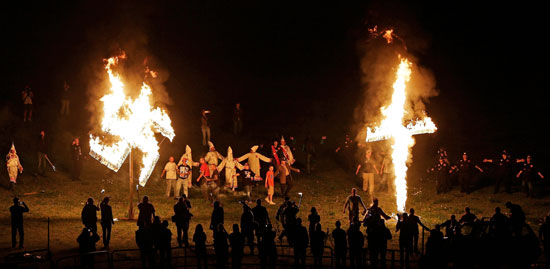
torches on their nocturnal
march to protest the dethroning of a statue of
Robert E. Lee. That brandishing of fire in the night was meant to
evoke memories of terror, of past parades of hate and aggression by
the Ku Klux Klan in the United States and Adolf Hitler’s
Freikorps in Germany.
The organizers wanted to issue a
warning to those watching: that past violence, perpetrated in defense
of the “blood and soil” of the white race, would once
again be harnessed and deployed in Donald Trump’s America.
Indeed, the very next day, that fatal August 12th, those nationalist
fanatics unleashed an orgy of brutality that led to the deaths
of three people and the injuring of many more.
Millions around America and the world
were horrified and revolted by that parade of torches. In my
case, however, they also brought to mind deeply personal memories of
other fires that had burned darkly so many decades before, far from
the United States or Nazi Europe. As I watched footage of that rally,
I couldn’t help remembering the bonfires that lit up my own
country, Chile, in the aftermath of General Augusto Pinochet’s
September 11th coup in 1973 -- that “first
9/11,” which, with the active support of
Washington and the CIA, had overthrown the popularly elected
government of Salvador Allende.
The Chilean people had voted Allende
in as their president three years earlier, launching an exceptional
democratic experiment in peaceful social change. It would be an
unprecedented attempt to build socialism through the ballot box,
based on the promise that a revolution need not kill or silence its
enemies in order to succeed. It was thrilling to be alive during the
thousand days that Allende governed. In that brief period, a
mobilized nation wrested control of its
natural resources and telecommunication systems from multinational
(primarily U.S.) corporations; large estates were redistributed to
the peasants who had long farmed them in near servitude;
and workers became the owners of the factories they labored in, while
bank employees managed their nationalized institutions previously in
the hands of rich conglomerates.
As an entire country shook off the
chains of yesteryear, intellectuals and artists were also challenged.
We faced the task of finding the words for, the look of, a new
reality. In that spirit, Belgian sociologist Armand Mattelart and I
wrote a booklet that we called Para
Leer al Pato Donald (How
to Read Donald Duck).
It was meant to respond to a very
practical need: the mass media stories Chileans had been consuming,
that mentally colonized the way they lived and dreamed of their
everyday circumstances, didn’t faintly match the extraordinary
new situation in their country. Largely imported from the United
States and available via outlets of every sort (comics, magazines,
television, radio), they needed to be critiqued and the models and
values they espoused, all the hidden messages of greed, domination,
and prejudice they contained, exposed.
If there was a single company that embodied the
overarching influence of the U.S. -- not just in Chile but in so many
other lands then known as the Third World -- it was the Walt Disney
Corporation. Today, in addition to the many amusement parks that bear
its name, the Disney brand conjures up a panoply of Pixar princesses,
avatars of cars and planes, and tales of teen-age angst and Caribbean
piracy. But in Chile, in the early 1970s, Disney’s influence
was epitomized by a flood of inexpensive comic books available at
every newsstand. So Armand and I decided to focus on them and in
particular on the character who then seemed to us the most symbolic
and popular of the denizens of the Disney universe. What better way
to expose the nature of American cultural imperialism than to unmask
the most innocent and wholesome of Walt Disney’s characters, to
show what authoritarian tenets a duck’s smiling face could
smuggle into Third World hearts and minds?
We would soon discover what an attack on Disney would be
met with -- and it wasn’t smiles.
Roast Author, Not Duck
Para Leer al Pato Donald,
published in Chile in 1971, quickly became a runaway bestseller. Less
than two years later, however, it suffered the fate of the revolution
and of the people who had sustained that revolution.
The military coup of 1973 led to savage repression
against those who had dared to dream of an alternative existence:
executions, torture, imprisonment, persecution, exile, and, yes, book
burnings, too. Hundreds of thousands of volumes went up in flames.
Among them was our book. A few days
after the neo-fascist takeover of Chile’s long-standing
democracy, I was in hiding in a clandestine house when I happened to
see a live TV transmission of a group of soldiers throwing books onto
a pyre -- and there was Para Leer al
Pato Donald. I wasn’t entirely
surprised by this inquisitorial blaze. The book had touched a nerve
among Chilean right-wingers. Even in pre-coup times, I had barely
avoided being run over by an irate motorist who shouted, “Viva
el Pato Donald!” I was saved by a comrade from being beaten up
by an anti-Semitic mob and the modest bungalow where my wife and I
lived with our young son Rodrigo had been the object of protests.
The children of neighbors had held up placards denouncing my assault
on their innocence, while their parents shattered our living-room
windows with some well-placed rocks.
Seeing your own book being burned on
television was, however, another matter. I had mistakenly assumed --
an assumption I still find hard to dislodge, even in Donald Trump’s
America -- that after the infamous Nazi
bonfires of May 1933 in which tons of volumes
deemed subversive and “un-German” had been consigned to
the flames, such acts would be considered too reprehensible to be
done in public. Instead, four decades after those Nazi pyres, the
Chilean military was broadcasting their fury and bigotry in the most
flagrant way imaginable. And of course it brought home to me in an
alarming fashion a simple fact of that moment: given the public fate
of my book, the perpetrators would have no compunctions about acting
with the same virulence against its author. The experience
undoubtedly helped persuade me, a month later, to reluctantly accept
orders from the underground Chilean resistance to leave the country
to assist in the campaign against General Pinochet from abroad.
 From
exile, I would then witness how our country became a laboratory for
the shock-therapy
treatments of the Chicago boys, a group of economists mentored by
Milton Friedman who were eager to apply the economic strategies of a
brutal laissez-fare capitalism that would conquer England and the
United States, too, in the Thatcher and Reagan eras. They
still, of course, reign supreme among conservatives everywhere,
especially the plutocrats around Donald Trump. Indeed, many of the
policies instituted and attitudes displayed in post-coup Chile would
prove models for the Trump era: extreme nationalism, an
absolute reverence for law and order, the savage deregulation of
business and industry, callousness regarding worker safety, the
opening of state lands to unfettered
resource extraction and exploitation, the proliferation of charter
schools, and the militarization of society. To all this must be added
one more crucial trait: a raging anti-intellectualism and hatred of
“elites” that, in the case of Chile in 1973, led to the
burning of books like ours.
From
exile, I would then witness how our country became a laboratory for
the shock-therapy
treatments of the Chicago boys, a group of economists mentored by
Milton Friedman who were eager to apply the economic strategies of a
brutal laissez-fare capitalism that would conquer England and the
United States, too, in the Thatcher and Reagan eras. They
still, of course, reign supreme among conservatives everywhere,
especially the plutocrats around Donald Trump. Indeed, many of the
policies instituted and attitudes displayed in post-coup Chile would
prove models for the Trump era: extreme nationalism, an
absolute reverence for law and order, the savage deregulation of
business and industry, callousness regarding worker safety, the
opening of state lands to unfettered
resource extraction and exploitation, the proliferation of charter
schools, and the militarization of society. To all this must be added
one more crucial trait: a raging anti-intellectualism and hatred of
“elites” that, in the case of Chile in 1973, led to the
burning of books like ours.
I carried into exile that image of our
book in flames. We had intended to roast Disney and the Duck.
Instead, like Chile itself, the book was consumed in a conflagration
that seemed to know no end. That the military conspirators and their
oligarchic civilian masters had been financed and aided by the
American government and the
CIA, that President Richard Nixon and his
National Security Advisor Henry Kissinger had worked to destabilize
and bring down the whole Allende experiment, only added a bitter
scent of defeat to the suppression of our book (and so of our
critique of their country and its ideology). We had been so sure that
our words -- and the marching workers who had stimulated them -- were
stronger than the empire and its acolytes. Now, the empire had
struck back and we were the ones being roasted.
And yet, though so many copies of Para
Leer al Pato Donald were obliterated
-- the entire third edition of the book was thrown into Valparaíso
Bay by Chilean navy sailors -- as with the Nazis, as with the
Inquisition, books are hard things to truly destroy. Ours was,
in fact, being translated and published abroad at the very moment it
was being burned in Chile. As a result, Armand and I nursed the hope
that even if How to Read Donald Duck
could no longer circulate in the country that had given it birth, the
version translated by art critic David Kunzle might, at least,
penetrate the country that had birthed Walt Disney.
It soon became apparent, however, that Disney, too, was
more powerful than we had anticipated. No publisher in the U.S. was
willing to risk bringing our book out because we had reproduced --
obviously without authorization -- a series of images from Disney’s
comics to prove our points and Walt’s company was (and still
is) notorious for defending its copyright material and characters
with an armada of lawyers and threats.
Indeed, thanks to the Disney
Corporation, when 4,000 copies of How
to Read Donald Duck, printed in
London, were imported into the United States in July 1975, the whole
shipment was impounded by the Treasury Department. The U.S. Customs
Service’s Import Compliance Branch labeled the book an act of
“piratical copying” and proceeded to “detain,”
“seize,” and “hold [it]
in custody” under the provisions of the Copyright Act (Title 17
U.S.C. 106). The parties involved in the dispute were then
invited to submit briefs regarding a final
determination of the book’s fate.
The Center for Constitutional Rights
took up our defense and, incredibly enough, under the leadership of
Peter Weiss, beat the serried ranks of Disney barristers. On June
9th, 1976, Eleanor Suske, head of the Imports Compliance Board, wrote
that “the books do not constitute piratical copies of any Walt
Disney copyright recorded with Customs.” As philosopher John
Shelton Lawrence pointed out in his account of the incident in Fair
Use and Free Inquiry, there was,
however, a catch to this “victory,” a “serious snag
in the final determination of the Customs Department.” Alluding
to an arcane law from the late nineteenth century as justification,
it allowed only 1,500 copies of the book into the country. The rest
of the shipment was prohibited, blocking many American readers from
becoming acquainted with the text and turning the few copies that
made it to these shores into collector’s
items.
Duck, It’s Another
Donald!
More than four decades have since
passed and only now, eerily enough in this Trumpian moment, is the
text of How
To Read Donald Duck finally being
published in the land of Disney. It is part of a catalogue
accompanying an
exhibition at the MAK Center for Art and
Architecture in Los Angeles.
I would hardly deny that, so many
years later, I find satisfaction in the continuing life of a book
once consigned to the flames, no less that its “birth” in
this country is taking place not so far from Disneyland or, for that
matter, from the grave at Forest Lawn Cemetery where the cremated
remains of Walt himself lie. (No, he was not
frozen cryogenically, as urban legend has it.)
No less important to me, our scorched book has snuck into the United
States at the very moment when its citizens, animated by the sort of
nativism and xenophobia I remember from my own Chile when General
Pinochet reigned, have elected to the presidency another Donald --
albeit one more akin to Uncle Scrooge McDuck than his once well-known
nephew -- based on his vow to “build the wall” and “make
America great again.” We are clearly in a moment when a
yearning to regress to the supposedly uncomplicated, spotless, and
innocent America of those Disney cartoons, the sort of America that
Walt once imagined as eternal, fills Trump and so many of his
followers with an inchoate nostalgia.
It intrigues me that our ideas, forged
in the heat and hope of the Chilean revolution,
have finally arrived here just as some Americans are picking up
torches like the ones that once consumed our book, while millions of
others are asking themselves about the
conditions that put Donald Trump in the Oval Office where he could
fan the flames of hatred. I wonder whether there’s anything
those who are now my fellow citizens could learn from our ancient
assessment of this country’s deep ideology. Can we today read a
second Donald into How to Read Donald
Duck?
Certainly, many of the values we
impaled in that book -- greed, ultra-competitiveness, the subjection
of darker races, a deep-seated suspicion and derision of foreigners
(Mexicans, Arabs, Asians), all enwreathed in a credo of unattainable
happiness -- animate many of Trump’s enthusiasts (and not
merely them). But such targets are now the obvious ones. Perhaps more
crucial today is the cardinal, still largely unexamined, all-American
sin at the heart of those Disney comics: a belief in an essential
American innocence, in the utter exceptionality, the ethical
singularity and manifest destiny of
the United States.
Back then, this meant (as it still
largely does today) the inability of the country Walt was exporting
in such a pristine state to recognize its own history. Bring to an
end the erasure of, and recurring amnesia about, its past
transgressions and violence (the enslavement of blacks, the
extermination of natives, the massacres of striking workers, the
persecution and deportation of aliens and rebels, all those imperial
and military adventures, invasions, and annexations in foreign lands,
and a never-ending complicity with dictatorships and autocracy
globally), and the immaculate Disney worldview crumbles, opening
space for quite another country to make
an appearance.
Though we chose Walt Disney and his
cartoons as our foil, this deep-seated belief in American innocence
was hardly his property alone. Consider, for instance, the
recent decision by the generally admirable Ken Burns, that
quintessential chronicler of the depths and surfaces of Americana, to
launch his new documentary on the Vietnam War, a disastrous and
near-genocidal intervention in a faraway land, by insisting
that it “was begun in good faith by decent people” and
was a “failure,” not a “defeat.”
Take that as just one small indication of how difficult
it will be to get rid of the deeply ingrained idea that the United
States, despite its flaws, is an unquestionable force for good in the
world. Only an America that continues to bathe in this mythology of
innocence, of a God-given exceptionalism and virtue destined to rule
the Earth, could have produced a Trump victory. Only a
recognition of how malevolent and blinding that innocence is could
begin to open the way to a fuller understanding of the causes of
Trump’s ascendancy and his almost mesmerizing hold upon those
now referred to as “his base.” My small hope: that our
book, once reduced to ashes thanks to an anything-but-innocent
CIA-backed coup, might in some small way participate in the renewal
of America as its better angels search the mirror of history for the
reasons that led to the current debacle.
There is, however, an aspect of How
to Read Donald Duck that might offer a
contribution of another sort to the quest upon which so many patriots
in the United States are now embarked. What stirs me as I
reread that document of ours today is its tone -- the insolence,
outrage, and humor that flow through every page. It’s a book
that makes fun of itself even as it mocks Donald, his nephews, and
his pals. It pushes the envelope of language and, behind its
language, I can still hear the chants of a pueblo
on the march. It brings back to me the imaginative enormity
that every true demand for radical change insists upon. It
catches a missing feeling of our age: the belief that alternative
worlds are possible, that they are within reach if we’re
courageous enough, and smart enough, and daring enough to take
control of our own lives. Para Leer Al
Pato Donald was and still is a
celebration of such imaginative joy that was its own best reward and
that could never be turned into ashes in Santiago or drowned in the
bay of Valparaíso or anywhere else.
It is that joy in liberation, that
alegría,
that spirit of resistance that I would love to share with Americans
via the book Pinochet’s soldiers could not liquidate or
Disney’s lawyers ban from this country. Now, it finally
finds its way into the very land that invented both Donald Duck and
Donald Trump. At a terrible moment, I hope it’s a modest
reminder that we really don’t have to leave this world as it
was when we were born. If I could, I might retitle it though.
What about: How to Read Donald Trump?
Ariel Dorfman, an emeritus
professor of literature at Duke, is the author of the play Death
and the Maiden, the upcoming novel
Darwin’s
Ghosts, and a new book of essays
Homeland
Security Ate My Speech: Messages From the End of the World.
He lives with his wife in Durham, North Carolina, and in their native
Chile.
[Note:
How to Read Donald Duck
has now been published in the United States for the first time in How
to Read El Pato Pascual: Disney's Latin America and Latin America's
Disney, the catalogue accompanying
an
exhibition at the MAK Center for Art and
Architecture in Los Angeles mentioned in
this piece.]
Follow TomDispatch
on Twitter
and join us on Facebook.
Check out the newest Dispatch Book, Alfred McCoy's In
the Shadows of the American Century: The Rise and Decline of U.S.
Global Power as well as John
Dower's The
Violent American Century: War and Terror Since World War II,
John Feffer's dystopian novel Splinterlands,
Nick Turse’s Next
Time They’ll Come to Count the Dead,
and Tom Engelhardt's Shadow
Government: Surveillance, Secret Wars, and a Global Security State in
a Single-Superpower World.
Thanks to Tom Dispatch.com, where this article originally appeared - without the image.
Copyright 2017 Ariel Dorfman
